
The job of an interior designer is to create functional, visually appealing, balanced, and sustainable spaces. However, there’s much more than creating designs and curating spaces.
To thrive in the field, an interior designer must also understand people, their minds, and their environments. Interior designing course very helpfull.
Enrolling in a professional interior design course can equip you with the specific skills clients and employers seek. This blog describes the skills you learn from an interior design course.
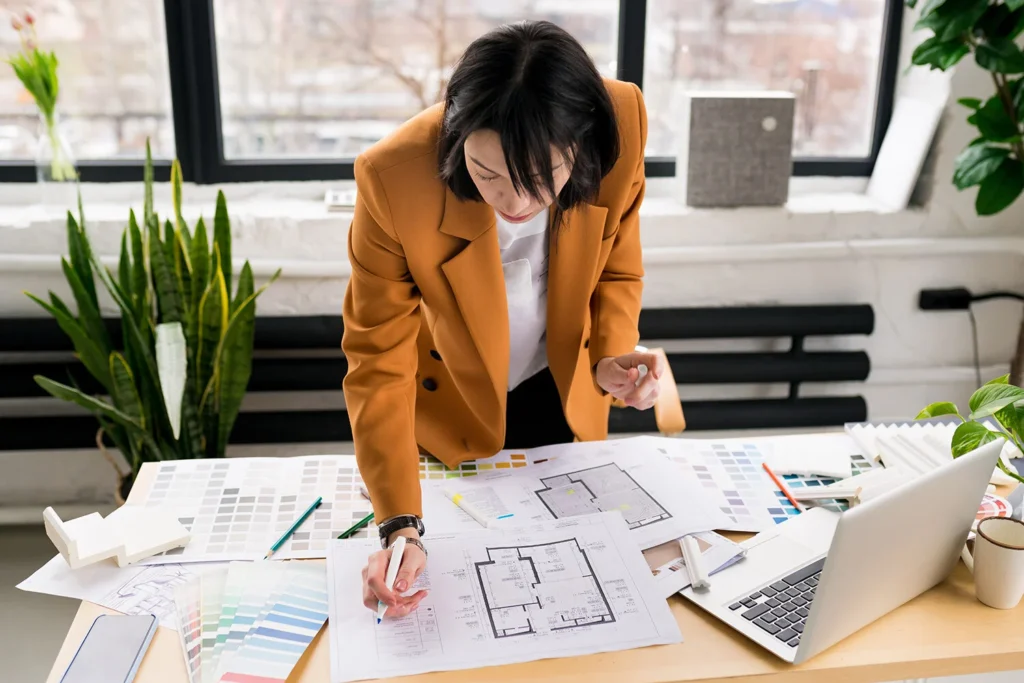
Top Skills You Will Learn in Interior Design Programs (Interior Designing Course)
Computer-Aided Design
Computer-aided design (CAD) software is used to create two-dimensional and three-dimensional models of architectural, engineering, and interior designs.
An interior design course teaches you how to use CAD to display your work to clients, including all elements and changes. The most popular CAD software is AutoCAD, Adobe Photoshop, SketchUp, CATIA, and Adobe Illustrator.
Drafting
Drafting is an alternative to design software. It represents the proposed project by drawing the space’s actual measurements and elevations by hand.
An interior design courses prepares you to create such accurate representations after gaining a feel of the space. The curriculum enhances your creative and analytical insights to plan and draw layouts.
Building Codes
Every construction project must adhere to national and state codes prescribed by government authorities.
Before renovating a space, interior designers must keep this in mind to avoid paying penalties or getting the project halted.
A reputed interior design institute ensures that interior design aspirants gain the required knowledge of these codes.
Light and Colour
A room’s aesthetic appeal changes significantly with the right colour scheme and lighting.
Lighting and colour theory is one of the top skills you learn from an interior course, enabling you to create an entire theme with the ideal combination of lights and colours.
It ensures you know how different colours work better with different materials and surfaces.
Materials and Textures
Materials and textures are as essential as lighting and colour. These elements play a crucial role in the visual appeal of a space and must align with the design theme.
A well-known design institute ensures you have an in-depth understanding of materials and textures to suggest the ones suited to the client’s requirements and budget.
Creativity
A successful interior designer must bring conceptual designs to visible reality. This requires an eye for detail and inventiveness.
An interior design course enhances your creativity by enabling you to visualise how an idea or concept would look eventually.
It teaches the different concepts of designing, colour schemes, functional landscaping, material use, construction techniques, and furnishing styles.
Critical Thinking Skills
Interior designers must evaluate situations and review all facts critically before arriving at a judgment. This skill is key for professionals to analyse ideas logically, find errors, and resolve problems.
An undergraduate, postgraduate, or diploma course in interior helps you improve your critical thinking skills to make you more independent and reflective.
Teamwork
Interior designers don’t work independently. You must cooperate and partner with vendors, suppliers, and other designers. Professional courses help you learn good teamwork skills to convey changes and updates smoothly, tackle risks unitedly, and deliver projects with deadlines.
Communication Skills
Interior designers must polish their communication skills to talk better and perform better in the workplace.
An interior design program at IADA (International Academy of Designs and Arts) enhances students’ communication abilities and teaches industry-specific vocabulary to help discuss designs, latest trends, updates and alterations with the team and avoid minor problems and issues.
Conclusion
Apart from the ones mentioned above, there are many other skills you learn from an interior designing course.
Following a learning-by-doing approach, these courses help you strengthen interior designing skills,
creativity, the use of the latest technology, and vocabulary to anticipate the latest industry trends and create comfortable spaces for living, leisure, work, recreation, and so on.